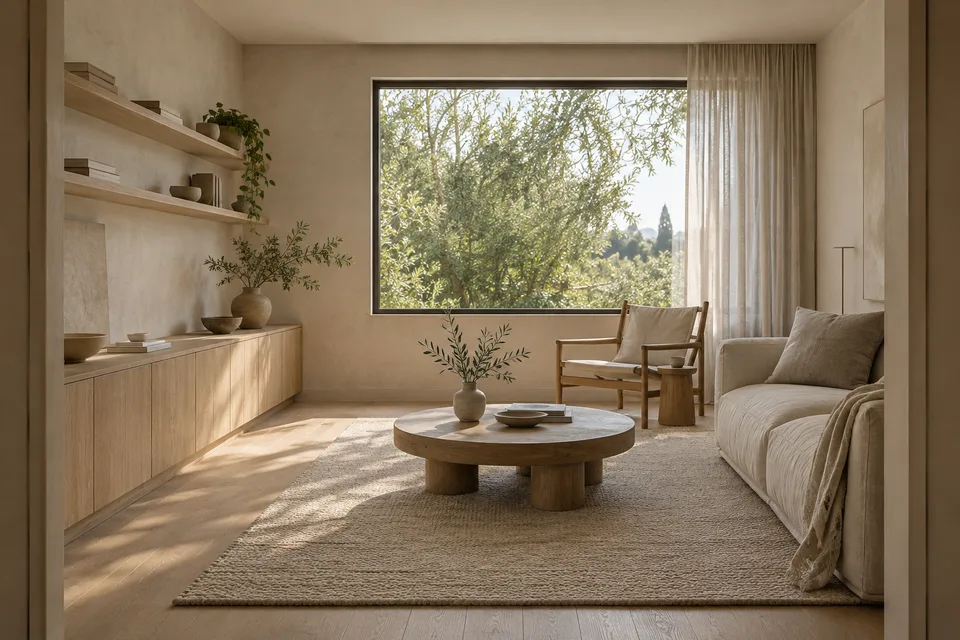
Pale oak, warm mineral walls, and linen. A calm material palette lets the light and the existing floor lead.
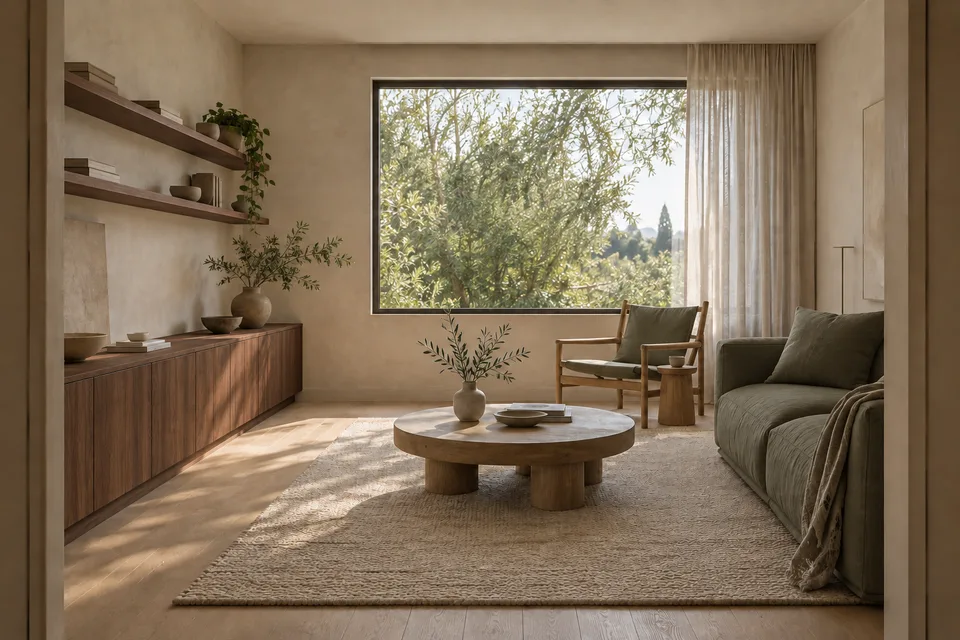
Darker joinery and olive upholstery give the same room a deeper character. An alternative study; Quiet Oak continues into the sample drawings.
Example 1: Quiet Oak
Quiet Oak is the selected route through The Window Room. The existing oak floor provides the starting reference, with pale oak joinery, warm mineral walls, and linen seating proposed around it. The board’s role is to explain that relationship, not to certify an exact color match.
Read the board from the room image to the material references. FIN-01 is the retained floor; J-01 is the proposed joinery; FIN-02 is the wall finish still awaiting survey and specification. Keeping those references visible makes a later schedule easier to understand.
Example 2: Deep Olive
Deep Olive explores darker joinery and olive upholstery in the same room. It is a comparison study, not a second completed project. Hold the room’s openings, retained floor, and functional brief constant so the client can discuss the material difference rather than an unrelated layout.
The sample drawings continue with Quiet Oak. Do not carry olive upholstery into a specification merely because it appeared on an alternative board. Record the selection and archive alternatives with their status intact.
Build a board with an argument
Start with a sentence describing the intended atmosphere. Choose a small set of references that support that sentence, then annotate what each contributes. A room image might explain light; a swatch might explain texture; a furniture silhouette might explain visual weight. If two images say the same thing, remove one.
- Keep the brief and retained conditions visible.
- Use images you own or have permission to reproduce.
- Label concept imagery, material samples, and product photographs differently.
- Record what the board does not settle: dimensions, suppliers, quantities, cost, and technical suitability.
Turn visual feedback into a decision
Ask what the client wants to retain, change, or investigate. “Too dark” becomes more useful when attached to the joinery, upholstery, or overall contrast. Translate the discussion into a concept decision, then develop the material board and product specifications separately.
Digital colors vary with lighting, photography, and screens. Physical sample review remains a separate step; an approved mood does not establish the final finish or authorize an order.
Record feedback without turning a board into an order
Use the same comparison question for both directions: what should remain, what should change, and why? Keep the retained conditions visible so a client preference is not accidentally attributed to a different room layout. This table is an authored exercise, not actual client feedback.
| Situation or reference | Useful record or next action |
|---|---|
| “Quiet Oak feels calmer.” | Record a material-direction preference; exact products still unresolved. |
| “We prefer the darker joinery only.” | Identify J-01 as the subject of a further study; do not adopt the whole alternative. |
| “Use that sofa.” | Clarify the visual preference, then develop the F-01 specification separately. |
Before you move on
- Can each image be explained in relation to the brief?
- Are alternatives clearly separated from the selected direction?
- Are unresolved product and material decisions recorded?
About this resource
Authored by OpenLintel with AI assistance. Examples are illustrative and have not received independent professional review. Adapt the structure to your practice and verify project-specific information. No legal agreement, regulatory compliance, or construction readiness is represented.
See the information connect
Follow the corresponding chapter of The Window Room: one illustrative brief, one selected direction, and coordinated sample references.
Explore the sample designDiscuss your studio’s workflow
Does this step lose information when your team moves to the next document? Discuss the coordination problem in a pilot discovery conversation. OpenLintel is in active development; this is not a hosted trial.
Request a pilot discovery conversation