Prepare the record and access arrangements
Assign a room reference and sketch the outline before adding dimensions. State the unit once on the sheet and repeat it where ambiguity is possible. Check instrument setup and follow its manufacturer’s instructions, including the measurement reference point.
Arrange permission and safe access before the visit. This is a documentation workflow, not a substitute for surveying training, site safety procedures, or specialist inspection. Do not disturb finishes or concealed services to complete a checklist.
Record geometry and openings systematically
Work around the room in a consistent direction. Record individual wall runs and locate openings relative to identified corners. Add relevant opening widths, heights, sill positions, and operation where they affect the brief. Note changes in ceiling height and visible obstructions.
Use a dimensioned sketch and a photograph register together. A photograph helps explain context, but it does not replace a measurement. Label inaccessible positions and uncertain readings so they cannot be mistaken for verified facts.
Use checks rather than assumptions
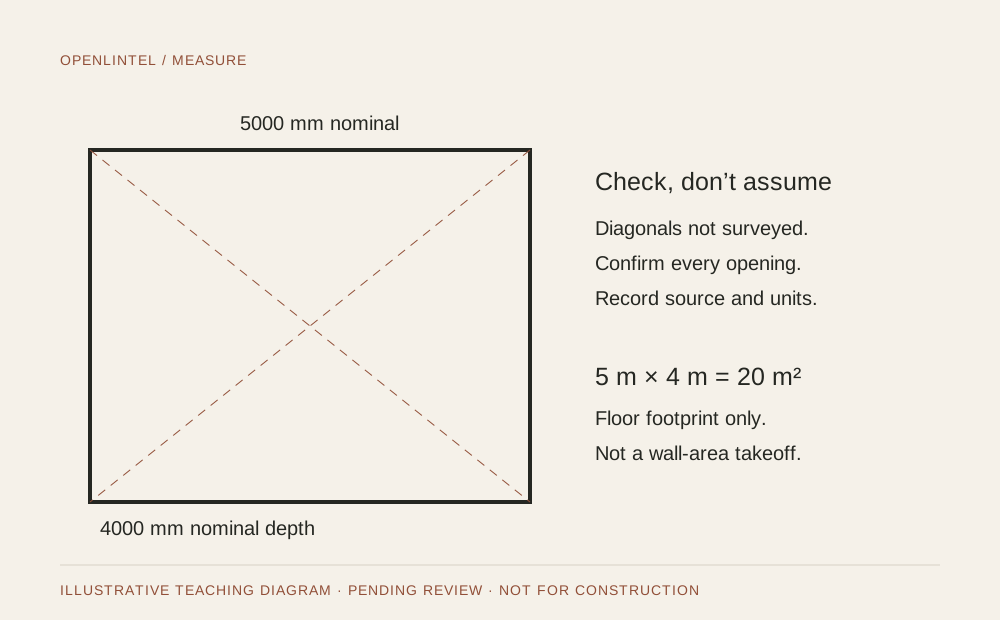
Compare overall dimensions with component runs and investigate differences. Where practical, diagonals provide an additional geometric check; Leica describes their role in confirming room geometry. Do not assume a room is rectangular merely because the sketch looks rectangular.
If measurements conflict, retain the observation and recheck the reference points. Do not average incompatible readings into a deceptively precise drawing. State any access or instrument limitation that affects confidence.
Understand the sample calculation
The Window Room’s nominal footprint is 5000 mm × 4000 mm: 5 m × 4 m = 20 m². This is a floor footprint only. It is not the area of the walls or a material order quantity, and the sample has no verified diagonals or opening survey.
Keep primary dimensions in one system. If an imperial reference is needed, label the conversion and its rounding. For example, 5000 mm is approximately 16.40 ft; that display conversion does not increase the accuracy of the original measurement.
- Record the source of every dimension used in a deliverable.
- Keep unknown dimensions visibly unresolved.
- Transfer confirmed information into the room data sheet.
- Arrange further survey before fabrication or construction use.
Preserve units and provenance during transcription
For US work, agree whether a value is feet and inches, decimal feet, inches, or a metric unit before entering it. Keep the primary measured record intact and label display conversions with their rounding. A conversion is not a new observation and should not create false precision.
| Situation or reference | Useful record or next action |
|---|---|
| Nominal fixture: 5000 mm | Keep “nominal, not surveyed” with the number when copied to the room sheet. |
| Provided plan conflicts with a reading | Record both sources and investigate reference points; do not silently average them. |
| Opening could not be measured | Record the access limitation and a follow-up action instead of estimating from a photo. |
Before you move on
- Are units and measurement reference points clear?
- Are openings, obstructions, and missing readings recorded?
- Have conflicting dimensions been checked rather than hidden?
About this resource
Authored by OpenLintel with AI assistance. Examples are illustrative and have not received independent professional review. Adapt the structure to your practice and verify project-specific information. No legal agreement, regulatory compliance, or construction readiness is represented.
Authorship, review boundaries, sources, and corrections
References
See the information connect
Follow the corresponding chapter of The Window Room: one illustrative brief, one selected direction, and coordinated sample references.
Explore the sample briefDiscuss your studio’s workflow
Does this step lose information when your team moves to the next document? Discuss the coordination problem in a pilot discovery conversation. OpenLintel is in active development; this is not a hosted trial.
Request a pilot discovery conversation